Bassist Jerome Lee’s Archive Blog

  • International School of Amsterdam_ To Teach (Originally posted on October 9, 2016)

    International School of Amsterdam_ To Teach (Originally posted on October 9, 2016)

      My days of living in Amsterdam, the Netherlands in the mid to late 1990’s found me playing music with a lot of different musicians. They were from all around the world. What this helped me do was to maintain a network of communication with the other numerous musicians in the city at that time. I had also begun to meet some of the musicians who were music teachers to supplement their income while living there. They all said that teaching music in the city was helping and enriching not only their students, but themselves as well. I too had done some music and bass guitar teaching before I had lived in Amsterdam. And by me having done so, it opened up a really nice chapter of my time spent in the city.

      As I had begun to meet musicians and artists at the many shows and open mic sessions that I went to and performed at, there was one Dutch man I met who asked me for bass guitar lessons. I said yes, and he would come to the little flat that I lived in to get his bass guitar lessons. They were fun times for both of us, and he did learn to play his bass much better after taking the time to learn and practice. It helped me to stay sharp too; teaching has a way of tapping into a very different area of our psyche as people. There is a need and a want to share and inform someone from the heart as a teacher. I felt this, and that feeling has always been a part of who I am.

      One of the great bass guitar players in Amsterdam asked me if I wanted to sit in with her band one night at a jam session. The band wanted to play a song or two from some charts they had on the stage. So, I played with them and read down the bass chart before me. It turns out that the very nice bass chart was written out beautifully by this great player, and she later asked me a bit more about myself. I had not been living too long in Amsterdam at this point, and I told her a bit about my history in music. We became friends and she would let me know of the many shows that she was playing in. I would go and see her play, and then she would introduce me to the other group members. Meeting those people was good for me later on, but something else happened that was a bit of a life changer for me.

      I also found out soon after through my friend that she was teaching music and bass guitar at the International School of Amsterdam. Located in the adjacent town of Amstelveen, she said that she had been teaching there two and sometimes three days a week. Once in a while she would teach more often there, but that is the schedule that she had settled into at that point. She told me one evening after a show that she had to go on the road with a great band and could not teach at the school for a while. And to my surprise, she asked me if I would like to take her place as a staff teacher at the school. Without a doubt, I was happily surprised and I said yes. There was some time before she was to leave on her tour, so that gave me some time to prepare myself too.

      The first day that I arrived at the International School of Amsterdam, I went inside and I liked it right away. I saw and heard students speak in languages from all over the world. It was amazing to encompass in my mind. I met with the music teachers on staff at the school; they all were very talented and very kind. I was glad to meet them, and glad to know them. I knew that this was something of a turning point in my life of living in Amsterdam; it was taking on something in a place that was new to me. It made the challenge so exciting, I was ready to begin.

      I was set to teach there at the beginning of the next school year. The music lessons took place after regular school hours as it was deemed extra curriculum school time. I also learned that my students were quite young. They were between the 11–13-year-old age ranges. And I looked forward to meeting their parents; talking with the parents of the students was something that was of great importance to me. I had remembered that importance when I gave bass guitar lessons in the U.S. The parents get to know me too; their minds were set at ease as I spoke with them. To me it is very important to have a good relationship with both the parents and the student while teaching.

      After the first school year that I taught was over, there was a music teacher’s meeting that we would be called to before the start of the next school year. It was here that I found out that we had to present ourselves at an assembly event before an auditorium filled with parents and relatives of the students, and many students themselves. You see, what we were trying to do was to gather some students for music lessons at the school. The assembly event allowed the teachers to display their chosen instrument and to show their ability to perform on it. Doing this would give the students a choice of which musical instrument they may be interested in learning to play. As teachers, we were good at getting the attention of the students with what we would play, like I said earlier, the music teaching staff at the school was very talented indeed. I did my presentation and performance before everyone and got a couple of laughs and some interest from the students.

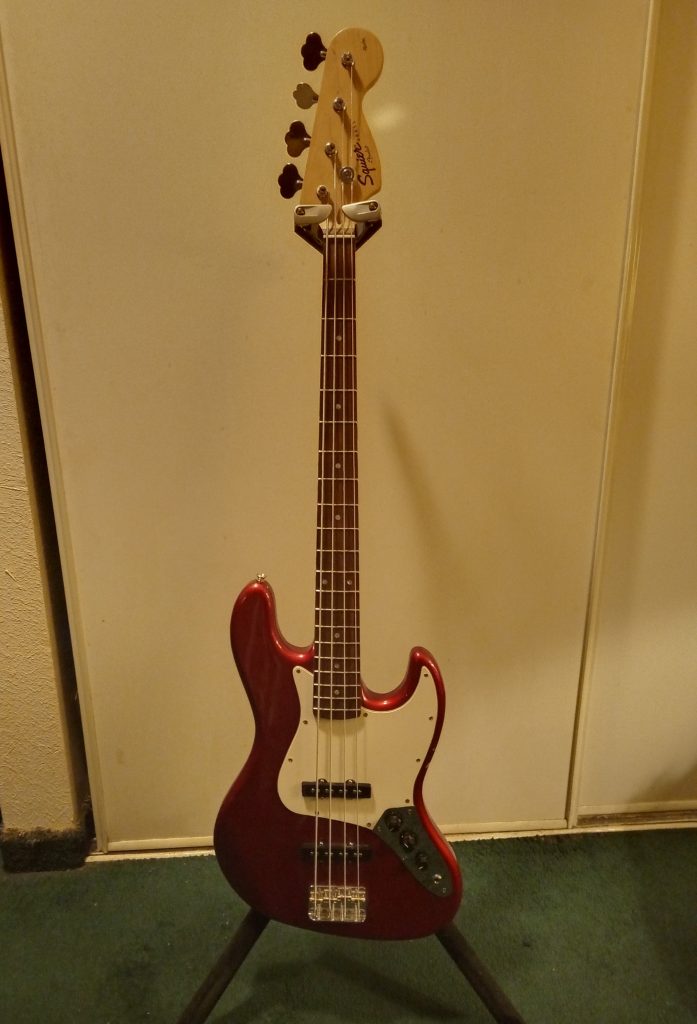
      After the assembly event was over that night, I met new students who were interested in learning the bass guitar, and I met their parents as well. It was really nice to have these new beginnings with new people, and good for me to impart to these students the things that I have learned about music over the years. During my second year, a couple of my students came to their bass guitar lessons with new bass guitars; I was very pleased that their parents took some of my advice on choosing a first instrument for their child. My students were of a young age as I said before, and having a 34″ scale neck might be a little bit too big for them to start on. So, a couple of my students arrived with a 30″ scale bass guitar to get their lessons with me. Having my new students show up with these new instruments further enamored me toward giving them the best bass guitar lessons that I could give. And yes, one of my students who was from Finland came to school with a 34″ scale bass guitar, but he could really play it. He wanted to know things about the bass that were a little beyond his abilities at the time, but I went on ahead and brought him along toward the place he wanted to be as a bass player.

      Part of the school curriculum during the school year at the International School of Amsterdam was to have an assembly event at the school auditorium to showcase the music students themselves. With all of the parents in attendance, it was a great way for those students to show their progress in front of everyone. One of my students wanted to participate in the event, so I worked up a very simple, blues-based song for us to share. I showed him how musicians take turns during the songs that they play, how they share solo space during the song. This particular young student of mine was from the north of England, and his accent was very thick when he spoke. I had lived for a year in England prior to living in the Netherlands, and I know how thick those accents can sound to my ear. He was a good student, and I could tell that he had been practicing his lessons. When he was comfortable with playing the song, I taught him how to let me know that he was ready to take his solo space in it by saying “let me in!”, and then he would begin to play his solo while I provided accompaniment for him.

      The night of the event at the school auditorium was really good. The music schoolteachers and their students did some really nice things with their music on the stage that night. It was a full auditorium, and my student and I did not have to go on first, so I saw a little excitement build up in him. I reassured him that we would be good out there. This was to be his very first performance playing a bass guitar on stage in front of people. When it was our turn, I got the two small bass guitar amplifiers set up with the help of one of the other teachers, and then we were introduced to the audience. As we began to play the blues song that we had been practicing together, I saw him relax a bit on stage, and we got a nice groove going. When he was comfortable playing the song on stage, he looked at me with an expression that I will not forget and said in a nice loud voice that I will not forget, “Let Me In!” The sound of his accent made me smile as he took his solo, and the audience reacted nicely as well. My young British student played his heart out, and I gave him the space to do his thing. It was such a great moment for him, and I was ever so proud of him playing the bass guitar like he did. His parents and siblings were excited for him after the show, his mother told me she could hardly get a word out of him most days as he was shy, but to hear him speak out on stage like he did was a real joy for her to hear.

      I went on to teach at the International School of Amsterdam for a total of just over three years. It was one of the most positive experiences that I had while I lived in Amsterdam, the Netherlands. To teach and to inform others is one of the most important things that we can do for each other as people. To have met such great music teachers, students, and parents is something that I will always cherish about my years spent living there.  Thank you ISA. 

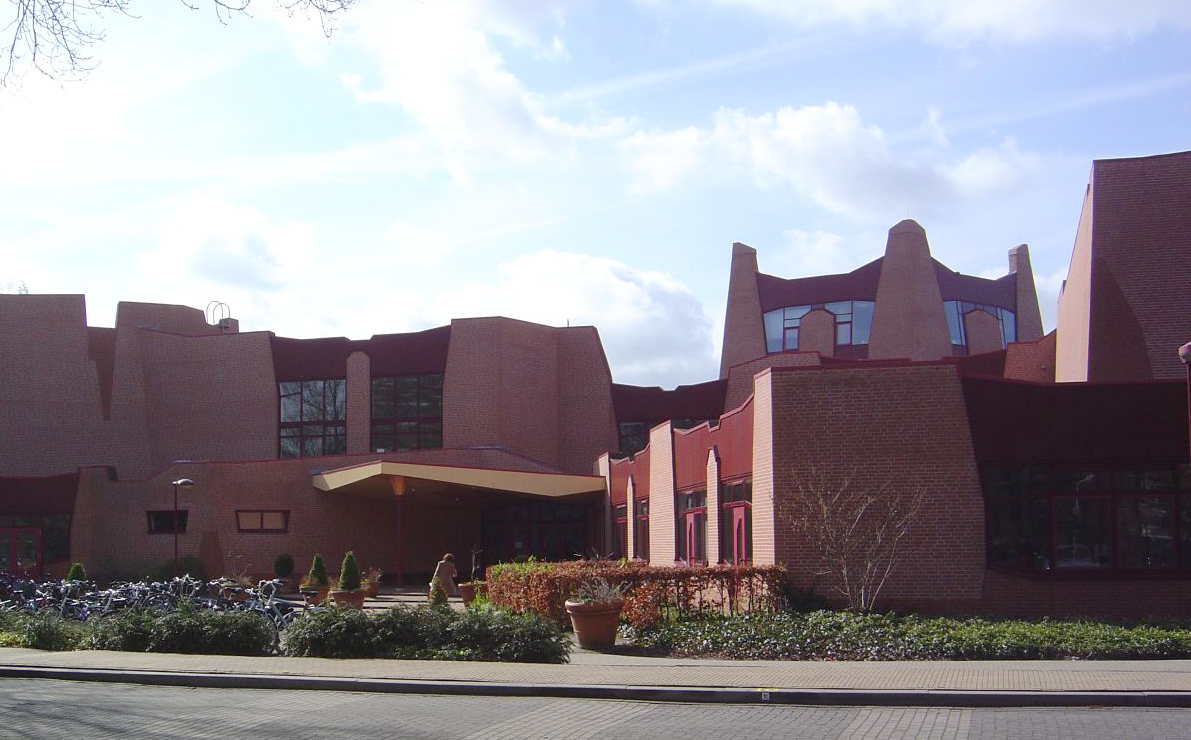
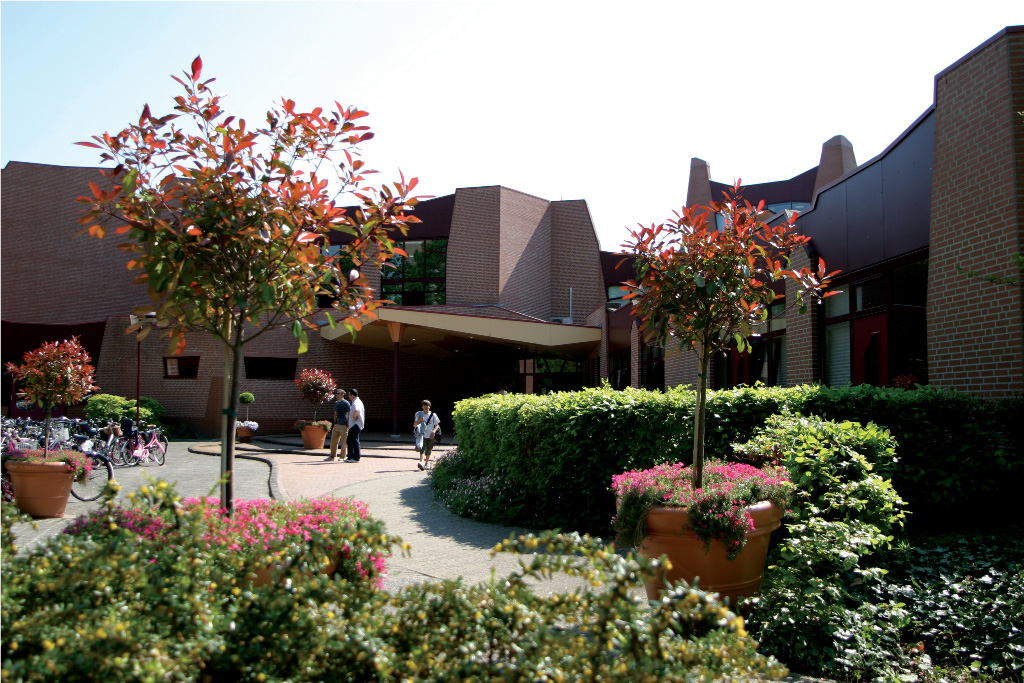
    The front entrance to the International School of Amsterdam, Amstelveen, the Netherlands, c. 2014
  • Japan (Originally posted on Oct. 2, 2016)

    Japan (Originally posted on Oct. 2, 2016)

      I never thought that I would ever visit the Far East in my lifetime, let alone live there. But it did happen to me. My life in the service offered me a chance to be stationed in the Far East, and I accepted my service branch’s offer. My assignment placed me on Honshu Island in Japan, and for me it was quite a culture shock at first. The time was late 1977, and my assignment was to run up to near the beginning of 1980. I had never lived outside of the US before at that point in my life, and here I was as a 20 year old taking it all in. It was fascinating, this island of Japan, and I wondered about what the culture there could exchange with someone like me. Well, I was about to find out in a good way.

      My fellow servicemen advised me to stay close to the installation at first, don’t wander off too far some of them said. But it turned out that I was much more excited and curious about my new surroundings than I had anticipated. There were a couple of guys there that I met who knew the island and had a car to drive. That was one way to get the lay of the land. Then there were some other guys that I met who knew the mass transit system in Japan rather deeply, it was with them that I got to understand the routes, times and locations of the mass transit there. And the mass transit introduced a new set of social rules for me to follow. It was the first time that I encountered the transit workers known as “Packers”; these uniformed workers actually push and pack people onto the train cars stopped at their stations during the transit travel rush hours in the mornings and the evenings. That to me was amazing to see, and to be a part of sometimes as I too was squished onto a couple of cars packed with transit riders during the rush hours.

      Driving a car is different in Japan too, they drive on the left side of the road, and so the vehicle’s steering wheel is mounted on the opposite side of what I was used to. One service member I met who was close to his assignment in Japan ending offered to sell me his mini van. It seemed in okay shape and the price was right, so I bought it. I drove it around the installation for a couple of weeks to get used to driving on the left side of the road. Then, I took it off of the installation on a regular basis and drove out in traffic with the rest of the native Japanese drivers. One driving habit that I did pick up from Japanese drivers was the habit of dousing my headlights when pulling up to a traffic signal at night. Almost all of the Japanese drivers did this; it was their way of showing each other a courtesy by bringing down their car’s headlights; this helped also to cut down the glare from the headlight’s reflections onto each driver’s rear-view mirror while stopped at a traffic signal at night. I carried this habit with me for a short time upon my return to the US, but I didn’t keep it for very long.

      I did bring over my first bass guitar to Japan with me. But I knew that it was time for a new bass soon, and in my travels, I found a nice little music store just outside of the installation where I was stationed. The store was called Three Sisters Music, and the store owners were very kind Japanese people and spoke just enough English to carry on a small conversation with me. Inside of that music store there were brands of guitars and basses that I had not heard of, Ibanez, Greco, and Yamaha instruments were on offer for musicians to try out. I liked the promotional posters on the wall inside the music store too; they were of acts named Pink Lady, Kasumi Watanabe, and even a nice poster of bassist Suzi Quatro. It turns out that Suzi Quatro was very popular in Japan during my time there.

      I continued to visit Three Sisters Music in the small town of Fussa in Japan as often as I could find the time to do so. It was a great store, and one of the owners there took a liking to me. She offered me some choices in bass guitars as I was definitely looking for a new one. After trying out a few bass guitars, I settled on one that she chose for me, it was a Greco bass guitar that was modeled after the popular Fender Precision bass guitar. I liked it right away, and came back to the store shortly thereafter and bought it from her. It was a nice bass to have for sure. After meeting a drummer in the barracks one day, I found myself playing in a contemporary jazz band that also played some r&b and soul music as well. The drummer was doing all of the band’s bookings as well as finding musicians to play in his band.

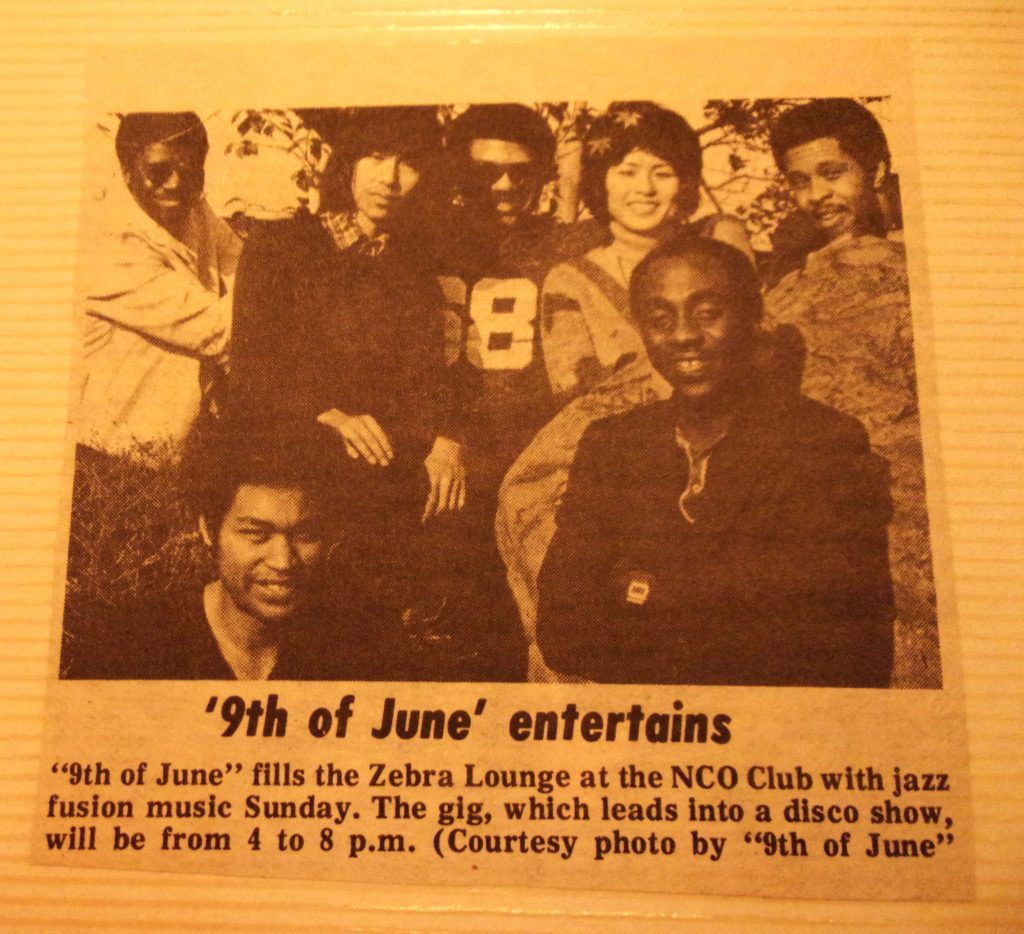
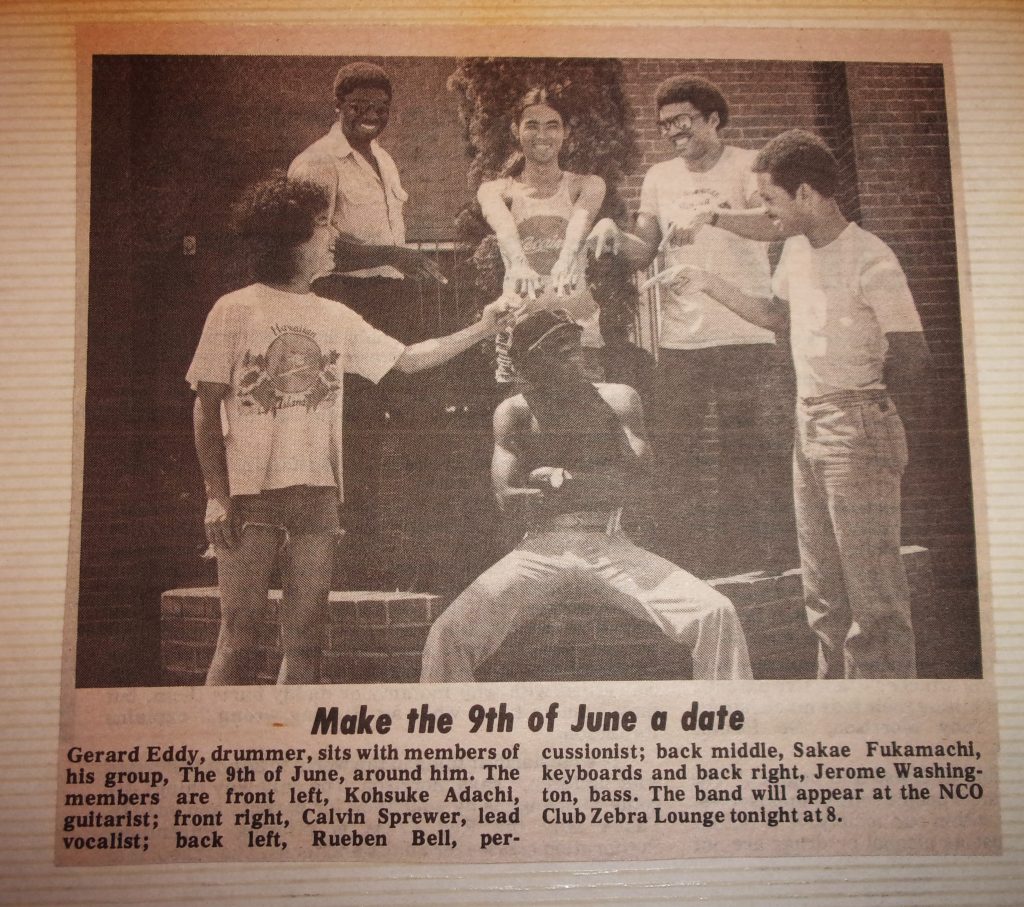
      That band, named the Ninth Of June, was the first true international band that I played in. The band’s makeup was a blend of African-American servicemen and Japanese Nationals; and we played together very well. The guitarist in the early band, named Kenny Moore, was an American and was very good, but his assignment came to an end and he returned to the US. The drummer then found a great Japanese guitarist named Keiji Yoshida, and Keiji stayed with the band until my assignment was over. We got to play together in that band for over a year and a half, and we did some of the best shows around the island of Honshu. I remember the first major concert that the band did, it was held in a nice concert hall in Fuchū. I wrote a new song for the band to play; we had rehearsed it before the concert. We took a little time together as a band at a little pub across the street from the concert hall, I remember being a bit nervous before our show. But one of the other Japanese guitar players that I knew there offered to share a shot of whiskey with me. It was my first shot of the famous Suntory whiskey, only one, and I was able to settle down a little bit before we had to play.

      The concert was really good, and when it came time to play my original song I was ready to do it. It was the first time that a band was playing a piece of music that I had composed before an audience, and I thought it was such a great experience and a blessing to have done so on Honshu Island, Japan. I took my bass solo space that I had written into the song with some real gusto. The band’s lead singer gave me the nickname of “Ironhand” after the song was over. By the way, I never did decide a title for my song, so I named it “Indecision”. We actually played it for the rest of the time that I was with the band, and I was always honored to play it.

      Keiji Yoshida was such a wonderful guitarist in that band. He taught at a music school in Tokyo where he had some 30 guitar students. We eventually played at Keiji’s school as a band; it was a real treat to play music for his students. He was a big fan of the band The Crusaders, he really loved their music. He liked the guitar styles of the Crusaders’ guitarists of that era, namely Larry Carlton and later, the late Billy Rodgers. Keiji also loved the way that the late saxophone player Wilton Felder played, Wilton’s melody ideas and solo ideas were something that Keiji was always interested in and admired. After playing together for about a year, Keiji came to a band practice one day with a new chart with a new song titled “Like Felder” that I just loved. The melody and that song’s sensibilities touched beautifully upon the spirit of The Crusaders music. And in the classic Crusaders style he wrote the main melody of that song to be played in unison with a tenor saxophone, it was just brilliant.

      As the time went by during my stay in Japan, I found myself returning to Three Sisters Music to look for yet another new bass guitar. The same lovely lady at the store showed me another Greco model that was a beautiful custom neck through body design that I really liked. I traded in my first Greco bass that she had sold me for the new one. I just loved this new bass. This lady from Three Sisters Music actually brought her husband along and came on to the installation one Sunday night to hear me play my new bass with the band, it was a fun and memorable night for us all. And it was also at a time when I knew that my bass playing was getting better, I was happy to know that I had progressed some more on my chosen instrument.

      A fellow serviceman helped me find some rehearsal space for the band to practice in on the installation. It was a good spot where we could play at show volumes and not bother anyone. Since there were three male vocalists also in the band, a public address (P.A.) system was needed for these singers. I was given keys to a medium sized van and was shown where to go and get the P.A. system for the band to play through. The place where the P.A. belonged was around an hour’s drive from the installation, it belonged to an audio professional named Aoshi Someya. I liked Someya when I met him, he had a great sense of humor and he knew a lot about the music scene in Japan and in the US. The name of his studio was Alfalfa Studios, and yes, it was named after the popular character Alfalfa from the Hal Roach TV series called The Little Rascals (Our Gang). Someya had several black and white photos of the Alfalfa character all around his studio, it always made me laugh when I would visit him to take care of the band’s P.A. system.

      Among the many gigs that the Ninth Of June played was a weekly night at a serviceman’s club on the installation. The gig was always on a Sunday night, and if the P.A. system was not already picked up by a certain time from Someya’s studio then folks would begin to worry a bit. So I made sure to make the long journey out to the studio a couple of days ahead of time. One afternoon, I had agreed to meet with Someya at his studio at a certain time. I drove the band’s van out to his studio in Musashi-Sakai to pick up the band’s P.A. system. But after ringing the bell to the studio, knocking on the door, and then trying to call Someya from a public phone and still not contacting him, I decided to wait in the van for a little while. But I didn’t stay in the van for very long; I saw a pub nearby that looked like it served food, so I went inside. The local Japanese folks inside welcomed me and I sat at the small bar and ordered a beer for myself. It was a lively pub, and lots of chatter came from the people as they met after their work day and talked about things.

      I was okay with sitting alone in the pub and waiting for Someya to return home. But a couple of curious Japanese guys came over to where I was at the bar, and one of them began to speak with me in broken English. This guy was doing his best to speak to me, and I tried my best to speak with him too. He would translate back into Japanese to his friend what we were speaking about. It turns out that they worked as local newspaper editors and story writers. They liked me and bought more beers, and talked some more. I did eat a little something there at the pub that night, remembering that I still had a long drive home. But my new Japanese friends were happy to speak with me, an African-American foreigner, someone that they didn’t meet every day. The beer kept coming. The big jukebox in the pub was loaded with 45RPM records, and the more folks drank, the more they would replay Bing Crosby’s version of “White Christmas”. You see, it did not have to be the holidays for the locals to play that song over and over again. They just loved it. For me, it was a little out there, but okay.

      A couple of hours later, Someya looked inside the pub and found me at the bar with my new friends. Our eyes met, and he could tell right away that I was feeling just fine, if you know what I mean. He came inside the pub and up to the bar where he immediately apologized to me for being so late. I told him that it was alright, and I introduced him to my new friends. They all spoke to each other in Japanese for a moment; Someya was telling them about my work as a musician, and my reason to visit him. My new newspaper friends were delighted to know this about me as we parted ways. The pub was fun, but Someya would not let me drive home that night. He put me up at his home to sleep overnight; it was such a kind thing for him to do for me. In the morning, he and his wife served me a traditional Japanese breakfast before I left, it was delicious. And the green tea that they offered me was excellent. 

      There are more stories about my working with this band during my years of living on Honshu Island, Japan that I hope to share in some later blogs. To have spent the time in Japan that I did was quite special to me. The people were kind, and the Japanese musicians that I met and played music with were stellar. I’m glad to have done that. Mata aim Asho.

    The 9th of June band in 1979 (front row) Kenny, Jerry (back row) Reuben, Keiji, Jerome, Mikiko, Calvin
    The 9th of June band, Japan 1978
  • Clothing Styles for Stage; What to Wear? (Originally posted on September 18, 2016)

    Clothing Styles for Stage; What to Wear? (Originally posted on September 18, 2016)

      It is fun to think about the styles of dress that I and other musicians have worn over the years. I know that I have worn a wide variety of clothing on stage during the past few decades.

    There has been the do-it-yourself look, that’s where everyone shows up to the gig wearing most anything that they like. It would be appropriate clothing for the stage though, but it just didn’t say to the audience to look at the band as a unit. It said to the audience to listen to us first and then have a look. Then there are the gigs where there is a more uniform look to what is worn by the band, not matching shirts or jackets necessarily, but a like color scheme to show the audience. It says to the audience that you can look and listen at the same time; it is a different kind of what I call a “show confectionery” for the audience.

      Then there are the gigs where the entire band wears the exact same shirt or jacket on stage. Jackets are one thing, but when it is matching shirts that are being worn by the band members then it is often (but not always) led by a front person who wears a shirt that is very close in color to the band member’s shirts. I have been in bands where the lead singer would wear the exact opposite colors of the band member’s shirts, and when the band plays well together and is very tight, then the “show confectionery” is presented in a different way that also has a positive impact on the audience. And when I say the band is tight, I mean a really good show style band that plays medleys and different readings of popular songs; for me those bands were a blast to play in.

      Some bands that I was in had a theme that ran throughout the music they created, and they would dress for the stage using the theme of the music that was to be presented. If the theme of the band’s music was love, then that would be the flavor of how the band members would dress. And on the other hand, if the theme of a band’s music was based in calling out social issues and bringing social injustice to light through the band’s music then the band members would dress for that. They would often wear things that I had never seen them wear until the date of the show, and sometimes what was worn would be stunning to me. I liked that part as well because it would bring out a set of unexpected emotions in me on stage that would make for a unique performance each show.

      The rock bands that I played in later on definitely had their own theme and their own style of delivering the music. I would listen first, but I would also watch very closely at what the band members wore. Especially the lead instrument player or the lead singer. They knew the true flavor of the music that they had composed, and they knew what kind of image and message they wanted to deliver to the audience. Paying attention to all of this found me in clothing stores of all kinds, looking for things to wear on stage. The effort was always worth it; I was able to find the type of stage clothing that spoke with the theme of the band’s music and message; as well as give a singular persona of myself to the audience while performing with the band. Back in the 1980’s when I was doing this, rock music was drastically changing, and the bands that I played in reflected this. The cross-genre styling of rock bands at that time allowed me to weave my stage clothing style into the ever-changing theme and styles of the music that was being played back then.

      Going back to when I had finished high school, I found myself in a great soul and r&b band that played all over Long Island and sometimes in New York City. It was mainly a cover band that played the soul, funk, and r&b hits of the early to mid-1970’s. Halfway through the 1970’s I enjoyed an awesome summer of playing music in this band. Since it was a cover band, the theme and the message of the music came through a few of the songs that it played; it was a horn section-based band with a lot of power. For us, wearing really big Afro hair styles was part of the norm back then. The bigger, the better. I even did a couple of shows wearing a pair of those wild platform shoes that men and women wore back then. Those shoes were very popular. But I found that my feet would hurt some after playing a really long gig in platform shoes, so I chose another shoe style a bit closer to the ground, and that made my feet a little happier. But that band definitely did surprise me with what they would wear to some of the shows we did, the lead male and female singers could dazzle an audience with just their voices alone. But what they would wear would also help to raise the band’s appeal to another level for each audience that we played to. And I did like my big Afro hairstyle.

      But when I started my first original jazz/rock style band at the start of the 1980’s, I wanted everyone in the band to dress well for each audience that we were to perform for. To me, it shows respect for the audience, and the one thing that I did frown upon in that band in its beginnings was the wearing of tennis shoes or “sneakers” on stage. A little later, I relaxed this view with this band as long as their shoes fit in with what we were trying to do. If someone did wear tennis shoes on stage, they needed to be clean and neat. Hey, it was my band, and it was all I could ask for. And the people in that band responded to the theme and style of the music that we composed and blended it with what we wore on stage quite nicely.

      Since then, the jazz bands and the blues bands that I have played in over the years have also had their own theme, style, and message to their music. Finding stage clothing for one of the contemporary jazz groups that I was in during the early 1990’s included dressing rather snappily on stage, and for me to wear a sport coat on stage for many of the shows was fun. It was a jazz band that was playing some modern styled music, it was quite original and the music did well on the national charts. Without a singer in that band on any song ever, there was still a bit of fun and a thrill for the crowd when the band leader would take a moment to remove his coat; and others in the band would also find a moment in the show to remover their own coats as well. It was fun for the audience to share those moments. Most of the time, if I wore a coat or a sport jacket on stage, I would wear it for the entire performance. If I would take it off at some point during any performance, it was always because it was too hot on stage, whether the band played indoors or outdoors.

      When I would play solo bass guitar shows, my own shows have a style and a bit of a theme as well. Playing solo, or even as a duo, you know that the audience is really going to scrutinize you from head to toe and really check out how you are dressed on stage. For those, I do pay attention to every aspect of what I wear, because I know that people are naturally going to look me up and down closely as I perform. Again, this is yet another type of “show confectionery” that can be bestowed upon the audience when giving a solo performance. I have seen solo performers dress in some really startling outfits on stage, but their music and their theme match up so well with what they wear.

      While the clothing styles have changed and even morphed over the years to the ever new, the musicians in bands will continue to introduce new looks on stage that amaze people and more. I think that it is fun to take a close look at what is being worn on stage by musicians and artists over the years. And I was glad to take part in what people saw and heard from the stage as an artist. And your style of dress is?…

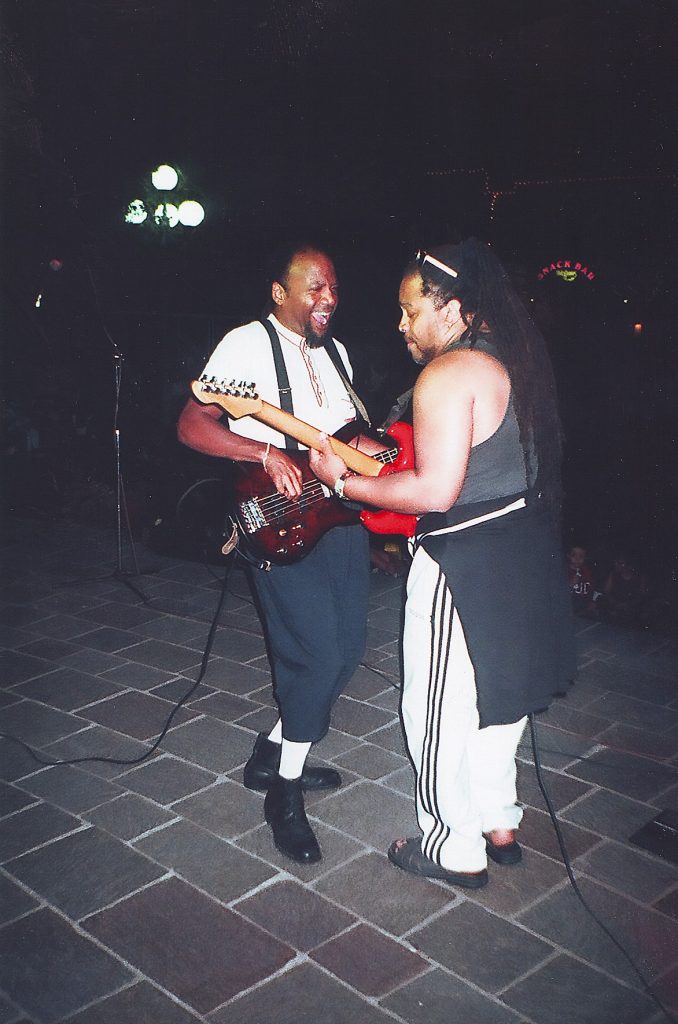
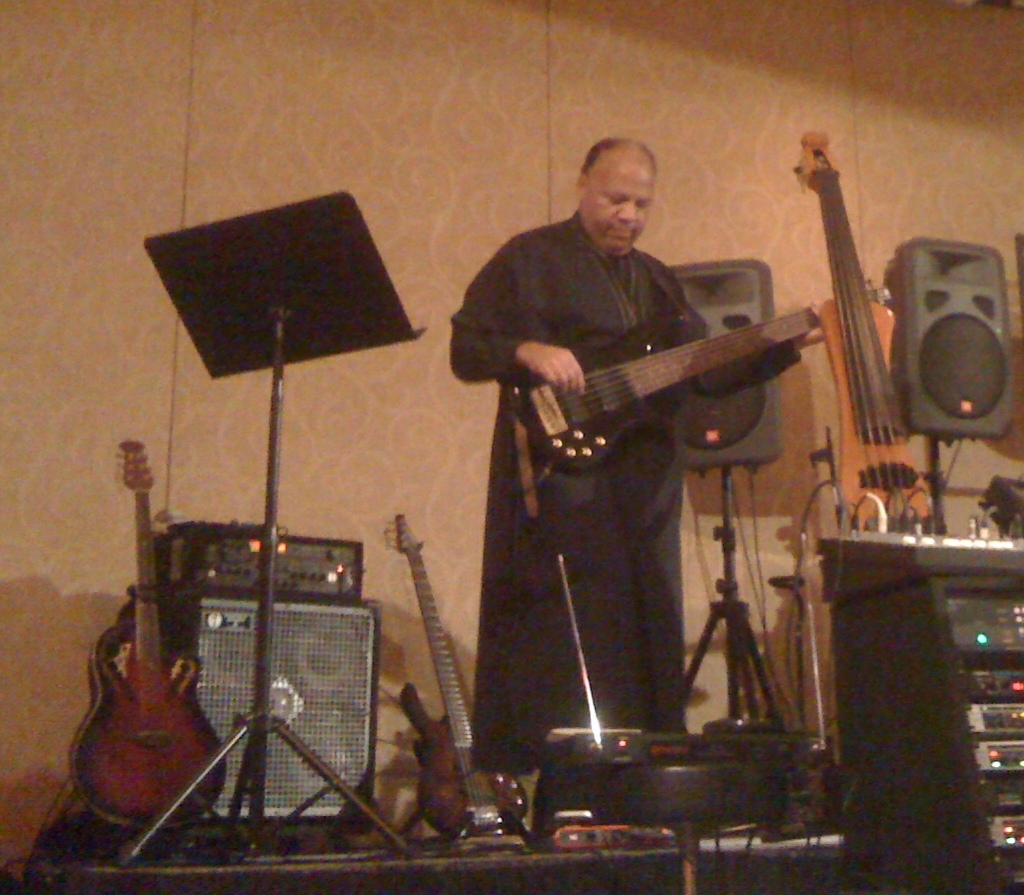
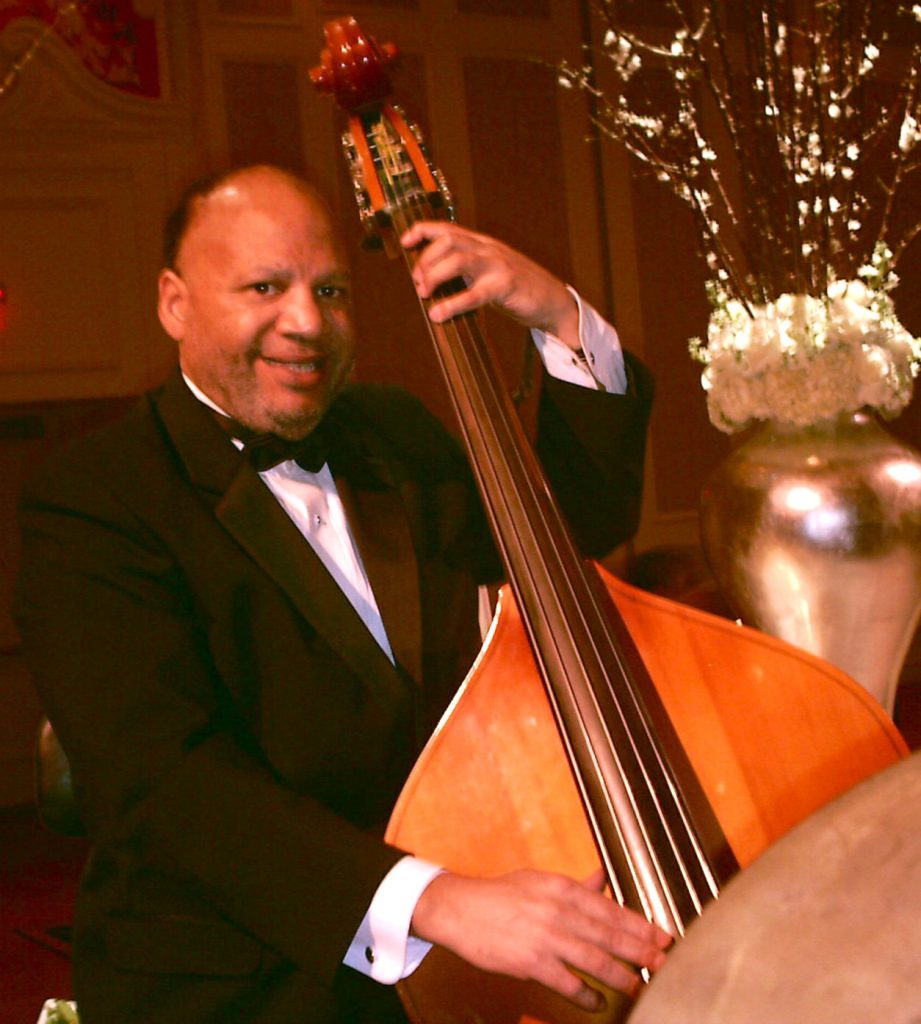
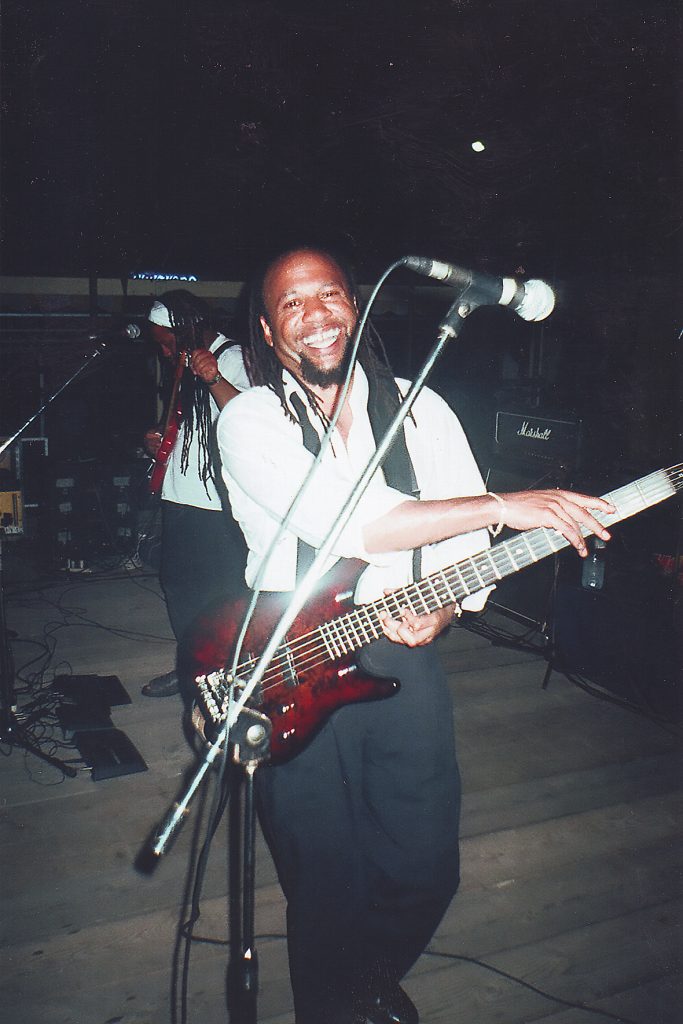
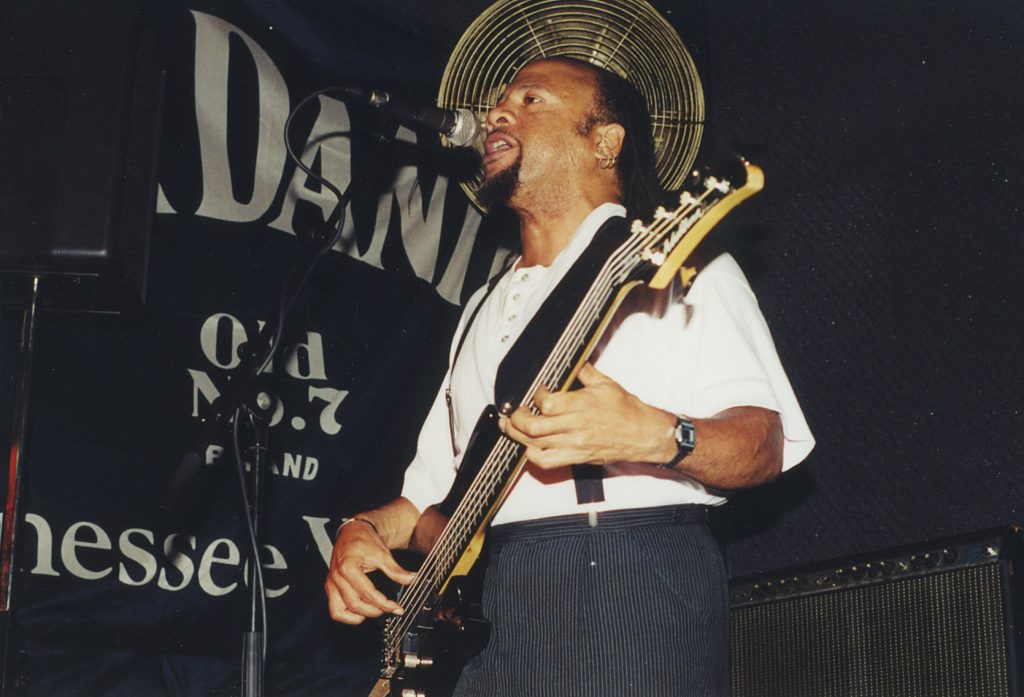
    Jerome Lee leading his group “Jerome Lee City” in concert in Sardinia, Italy 1998
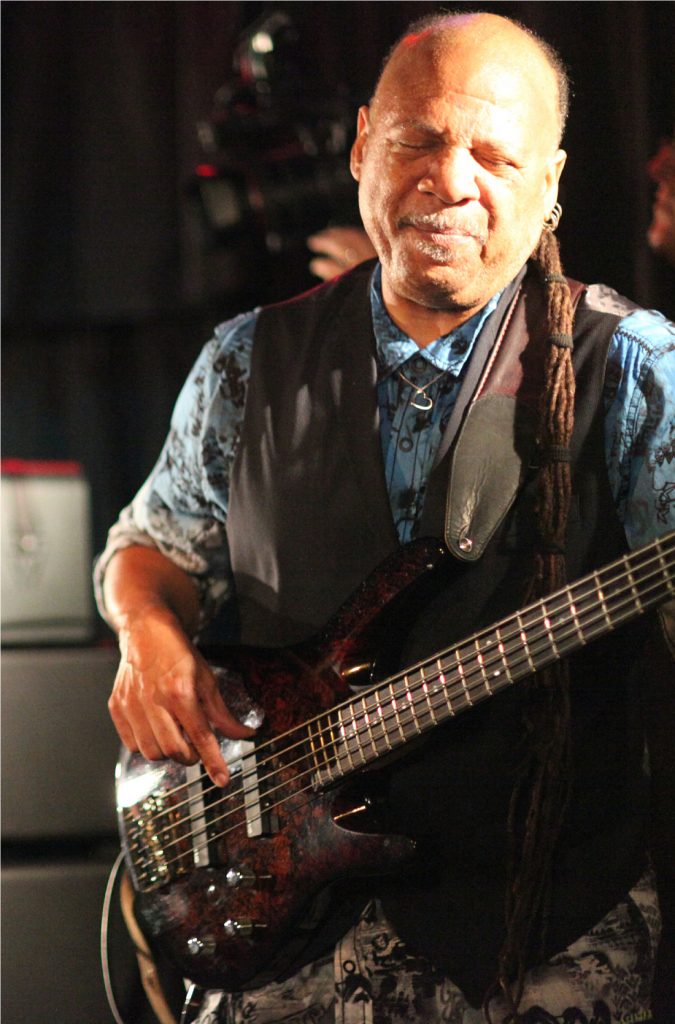
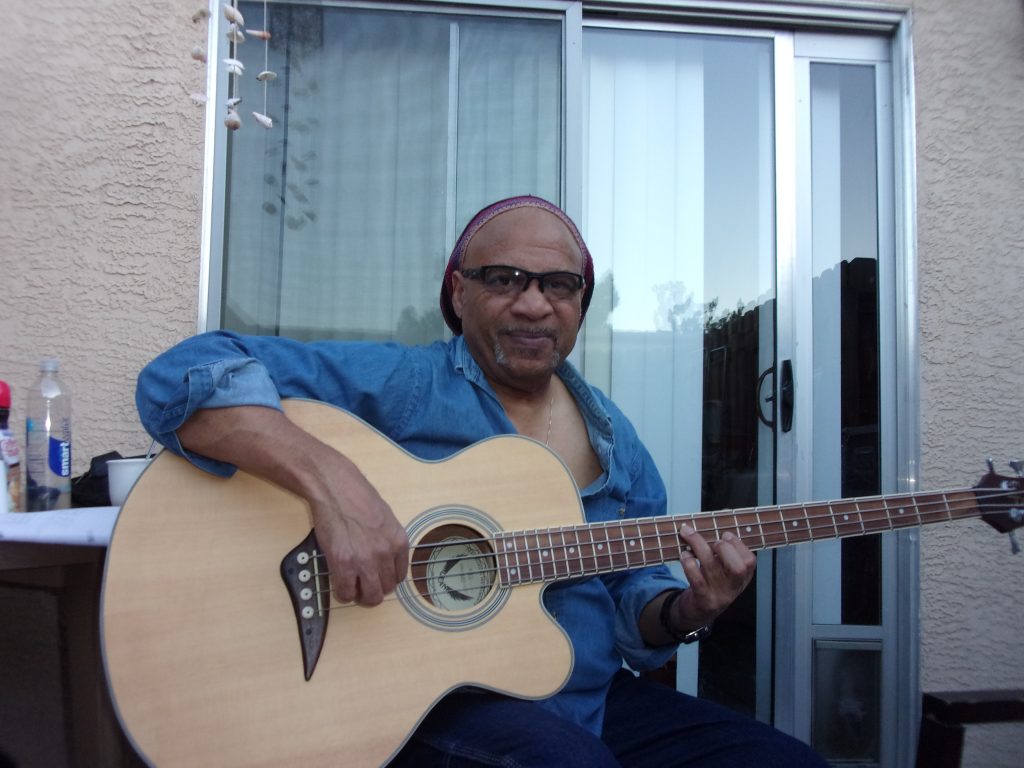
    Jerome Lee performing at his solo bass guitar show in Las Vegas, Nevada 2014
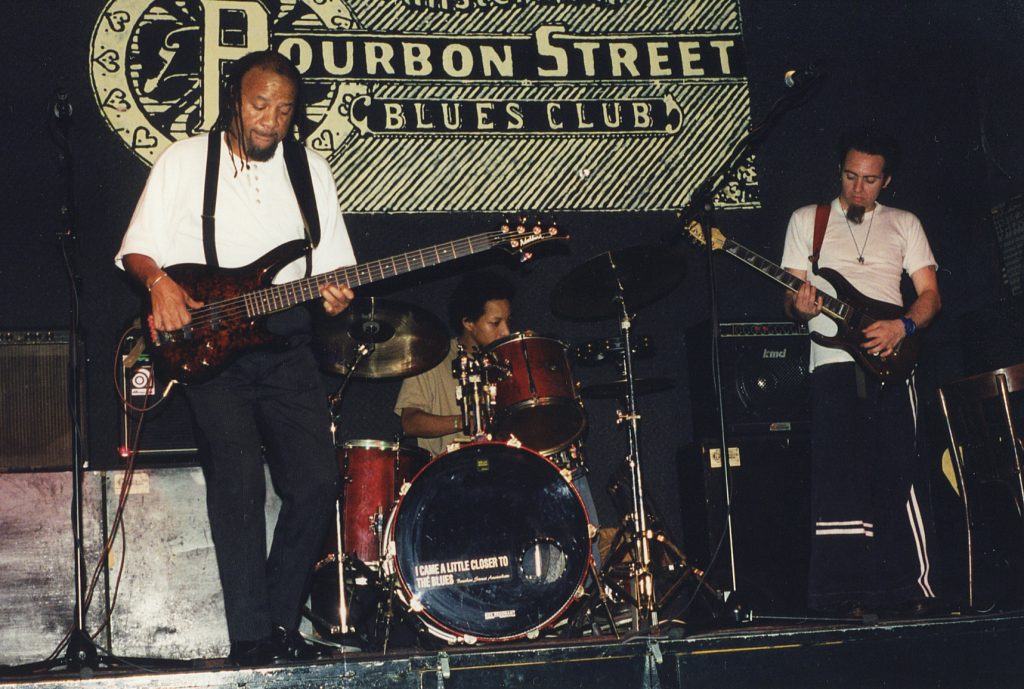
    Jerome Lee leading his open mic/jam night at Bourbon Street Blues Club Amsterdam, the Netherlands, 1999
    Jerome Lee in a duet concert in Las Vegas, Nevada, 2016
  • Los Angeles Days I (Originally posted on September 11, 2016) 

    Los Angeles Days I (Originally posted on September 11, 2016) 

    It was the best of times, and the worst of times, all at the same time; my days in Los Angeles in the mid to late 1980’s. I was playing the bass in several bands, sometimes different gigs in the same week with different bands. So crazy. Oh, and recording too, I learned to keep a “bass mobility kit” together for those last-minute studio calls when they happened. Word of mouth around Los Angeles about you as being a good bass player will help facilitate this, I quickly learned. 

      The festivals in the city were a joy to play at; the Sunset Junction Street Fair, and the West Hollywood Street Fair, among others, were the best, to me. There were other festivals, but those two stood out during my days of playing bass with the band known as Urban Artillery. I saw that the band was asked to return to those festival band line-ups for a few years running during the late 1980’s into the early 1990’s. 

      I loved playing in this band, as I was one of its two (yes two) electric bass players, and the drummers that did pass through the band were simply amazing. One drummer who played with the band at a West Hollywood Street Fair concert one year went on to play drums in the touring band for Kris Kristofferson. And yet another drummer who joined the band for a concert performance at the Sunset Junction Street Fair went on to play drums in the band called 4 Non Blondes. The band had a strong social message and stage presence that many people in Los Angeles took to and really liked.   

      The festival’s organizers liked the raw power of the band; they liked its originality and its style. I remember a couple of memorable performances at the West Hollywood Street Fair, and one in particular where I, the keyboard player, and the lead singer, were jumping really high into the air on stage during a particularly rousing song. The lead singer did a jump with a kick that launched one of his shoes at least 40 feet back into the audience. 

    We found it hilarious as a band, and wouldn’t you know it, someone in the audience returned the lead singer’s shoe after the band’s performance that afternoon. That’s the kind of people who attended these festivals back then; they loved the bands and saw them all as original with something to say, and stars in their own right whether they became big or not. 

      It was the worst of times because of the nature of the music industry itself. It is an extreme hit or miss industry, and those who miss find it hard to move forward, but not always. As a band, just because you miss once or twice back then didn’t mean that you weren’t going to get another shot at the big time. 

      This was Los Angeles after all, one of the key cities in the country to make a way forward in the music industry. And some of the bands there did move forward with their careers in music; a couple of them are still together today from back during those years that I lived there. And they still sound great. But not all of the bands made their way forward; not all of the bands found a lucrative career in the music industry. It was a tough way of living for me as well as so many other musicians that I knew back then. 

    Throughout the passage of time though, I have seen many of the band members from several of the bands that made music in Los Angeles back in those days on today’s social media, and one thing is in common between those days and these times. Our love to play music is above all else, and in the end, it didn’t matter so much whether there was a lucrative music industry deal or not. What did matter was the fact that we were and are musicians first, and we continue to compose and play the music that comes from our hearts, spirits, and souls. 

    And that’s a pretty good place to be.

    The single “Beautiful Country” by Urban Artillery in Los Angeles, CA, 1988
    Urban Artillery in Los Angeles circa 1988
  • My Sisters (Originally posted on September 4, 2016) 

    My Sisters (Originally posted on September 4, 2016) 

     I did not grow up as an only child; I had sisters and a younger brother around me. My two older brothers were old enough to be out and living on their own by the time I had discovered my interest in playing the bass. I have two older sisters closer to my own age, and one younger sister. I speak of them lovingly here because of their unknowing involvement in my musical development, in my bass playing. 

      My two older sisters were the ones to go out and buy all the new recordings of the day. Back in the late 1960’s and early 1970’s music spoke loudly to the masses, and if a person wanted to be in touch with what was considered cool, they had to know about the latest release of certain songs, or more specifically, the messages contained in the latest releases. My older sisters brought home so many records during this time; we listened to 78RPM, 45RPM, and 331/3RPM discs as often during the days and nights as possible. My sisters were quick to point out the message in the music to us younger ones; they were trying to get us in touch with the times that we were living in, trying to bring us up to date in a way. 

      As the love of music by my older sisters unfolded in front of me, there was all kinds of music that they brought home from the record stores; it was every genre, and they did not discriminate. Lots of soul and funk music, lots of r&b, lots of rock, lots of Latin soul, lots of blues; even Caribbean and Reggae music, found its way onto the turntables in the house. It helped to have a couple of inexpensive turntables in a couple of different rooms in the house. I remember the Christmas that my older sisters received a new turntable setup for their records; they were ecstatic, and that was when an intense musical education began for me. 

      The year that I got my first electric bass guitar and bass amplifier, I began to learn how to find the bass notes that I heard being played on the many records in my older sisters’ large record collection. I was taking electric bass guitar lessons from a neighborhood music teacher, he was great, and he taught me the fundamentals of playing the bass that stay with me to this day. But at the time, those fundamentals were also helping me to understand the role of the bass guitar in a group or band setting before I had even joined my first real band. In the school system that I went to at that time, I was also playing the upright bass in the school orchestra, and reading scores with bass notation printed on them. I used to think at first that this was the way that I was going to interpret music during my lifetime, by reading scores and playing in orchestras. 

    But learning to listen by ear and to try to copy the bass line that I was hearing on all of these different records was a huge revelation to me. I learned so much; that all the recordings were not recorded and mastered at the same level; the fact that all of the recordings were done to analog tape, and thus the overall tuning pitch would vary from record to record; the fact that the bass track on the record could be sitting either very forward or very far back in the overall mix. Before playing along to some of my favorite LP records, I would have to play a sample of a song to get a reference note to tune my bass to, and after I had re-tuned my bass, I would then play along with the entire record. 

      I learned so many different songs in those earliest years of my bass playing, and it turned out to be a real gift to me later on. Sometimes on weekend nights, when me and my sisters and brother had time, I would get my bass and small bass amplifier out and set it up to play along with the favored records of the day. We all loved to dance, and when I was playing along on my bass to a really popular song, the low end was much more fun to dance to; everybody wanted to dance to that record. My sisters began to marvel as I learned so many songs note for note on my bass, and after doing this for a couple of years, they couldn’t tell if I was playing along or not, especially if my bass amplifier’s level matched the stereo’s volume level. We would all laugh at that experience; it was fun for us all. 

      I found that all my sisters became my first fans, and when the adults would gather at the house on weekends and during the summers, my sisters would tell me to go and get my bass and amp to set up and play along with their favorite records. It turns out for most every musician that your family is your first audience, and to play my bass in front of the adults was as much a thrill to me as it was for them. They responded well, and they gave me encouragement to continue to play the bass. Because of the kindness of all of my sisters, I had a positive start to my early bass playing life. It is because of them that my mind was opened up through music to the times that we were living in. They showed me that there is a message in the music that we hear. They tried to get me to listen for a message each time I listened to music, and that sometimes I would have to listen a few times to a song before I really understood it. That there is a message in the music. And there is. 
    Thank you, my sisters, I love you.

  • The Bass (Originally posted on August 28,2016) 

    The Bass (Originally posted on August 28,2016) 

    The Bass. My love for the instrument goes back many years now. In fact, when I got my first electric bass guitar, the electric bass guitar itself as an instrument had been sold to the public for only 19 years. So, I started early in my life with an instrument that was still relatively new to the general public. 

      Oh yeah, the Beatles and the British invasion had come to America and done their thing, and people bought more and more musical instruments, bass guitars among them. Motown Records and Stax Records were hot too, and their artists inspired many other people to take up an instrument of their choice. There was a lot of inspiration coming from the artists and the music of the mid 1960’s that in turn launched the next movements of music in the country. 

    The LP records that my older sisters bought had us kids dancing and playing lots of air guitar (and bass). I remember some of the names of the early electric bass guitars that I saw as a kid; Gibson, Fender, Hagstrom, Rickenbacker, Kay, Danelectro, Carlo Robelli, Guild; even department store retailer Sears had their own name brand guitar (the Silvertone) on offer. I was seeing the bass being played by both men and women, but at that point in my young life I did not yet own one myself. 

      It’s because my first instrument (after learning to play the flutophone/recorder) was the viola and my future thoughts about it at that time in my life were the reason why I did not have a bass guitar. I was in the elementary school orchestra, and my music teacher was giving me lessons on the viola that were having a positive impact upon me. I mean, I was getting a good tone on the instrument at an early age. My young fellow orchestra players liked my sound. And as the neighborhood kids I went to school with would watch me carrying my viola in its case back and forth from school on the bus, one day they challenged me to play it in front of all of them at our bus stop one morning. 

    It was cold and snowing that day, with a good amount of snow already on the ground, and more coming down. I grew up on the east coast, on Long Island, and the winters there could be rough sometimes. But I was undaunted in front of those kids that morning. I had been practicing my scales and etudes. I had been rehearsing with the school orchestra. And like I said earlier, I had a good tone on the viola. 

      Snowing or not, I set my case down in the snow, and I took my viola out of the case with no hesitation, quickly tightened up the bow a little and then proceeded to play Greensleeves right in front of them all. I knew the song from memory, so I played it down. A good tone goes a long way, and the kids became excited and clapped their hands after I was done playing the piece. 

    That moment and that day put me on the road to thinking that the viola was going to be my instrument for life. From my sixth-grade year going into my seventh-grade year, I began to imagine my future self having finished college with a music degree and dressed nicely in a tuxedo playing the viola with a fine orchestra somewhere and making a good living doing just that. While those were good thoughts to have about a future playing the viola, life has its own way of stepping in and changing the circumstances of how we live out our musical lives. And step in it did. 

    Arriving at my school district’s junior high school as a seventh grader, viola in hand, I thought that I would begin to learn to play more difficult music on the instrument. I noticed this starting to happen in elementary school; the music became more difficult to play with each grade we advanced as students. I was alright with that; I simply wanted to get better, to sound better on the viola. About a month and a half into the new school year though, that’s when life stepped in, and brought along its change for my own musical life, and a profound change indeed.  

      The junior high school orchestra had a good sound to me, and we were learning to play in tune much better than in elementary school. I could easily hear when we were not in tune as a viola section, and if too many mistakes were made, the conductor would then stop the orchestra and make the viola section play their parts alone as a section. This of course would single out those who needed to work on that particular piece as a player or would help to clear up issues like timing. While this was going on, I was concentrating on the viola part in front of me, and I really could not hear the entire orchestra from my chair in the viola section. But my conductor could easily hear the whole orchestra, and he was beginning to have an issue with another section of the orchestra, the upright bass section. Why? Because there was only one upright bass player in the orchestra at the time! Of course, it would be difficult to hear his parts when everyone played. So, what did the conductor do? He asked me privately one day at school to consider learning to play the upright bass. “I can’t hear the bass parts when we play our pieces, and I think that you might be a good bass player if you give it a try.” He added, “If you don’t like playing the bass after the Winter Concerts, it’s ok, you can go back to playing the viola and we will be fine.” 

      Looking at the sheer size of the upright bass made me wonder how the students in the elementary school orchestra were even able to play it. I was used to the size of the viola, and the size of its strings. “Why play such a large instrument?” I thought. But the key to this time in my life was my music teacher, who was also the school orchestra’s conductor. He spoke to me in a kind voice, and it was ok for me to make a mistake on the bass while I was learning to play it. He showed me how to read the f-clef (bass clef), because during my years playing the viola I had learned to read the c-clef (alto clef). I quickly began to look forward to having our music lessons at school, I remember learning the Arco techniques, which is playing with a bow, and how I struggled with trying to get a decent tone on the upright bass. It seemed much easier for me to play the Arco techniques on the viola. One day, during a bass lesson at school, I was holding the upright bass rather far away from my body and holding it like that makes it even more difficult to play. I was struggling that day, and I did not know why. 

      But my bass teacher saw exactly what was going on, and why I was struggling to play. He came up behind me, grabbed the body of the bass with one hand, and my shoulder with the other and brought the upright bass right up against my body. Then he said to me, “Hold this instrument close to you like it’s your girlfriend!” I laughed like only a twelve-year-old kid could laugh, and no, I did not have a girlfriend at that time. But I certainly got the meaning of what my music teacher was trying to tell me. Holding the upright bass close to my body made all the difference in my playing as I could really feel the deep vibrations that emanate from its great size. 

    And the idea of holding the instrument close to my body was not lost on me. From then on, it mattered more to me, in more than just a physical sense. It also mattered in my life’s perspective as I began to love playing the upright bass from then on, that love was close to me too. I stayed with it, and after the junior high school Winter Concerts, I continued to play the upright bass and did not go back to playing the viola. And a year later, I finally got my first electric bass guitar, a Kimberly four string model that was violin shaped like the famous Hofner basses that Paul McCartney played in The Beatles. 

    It’s the beginnings of how I got here, and it has been my life’s instrument. 

    The Bass.

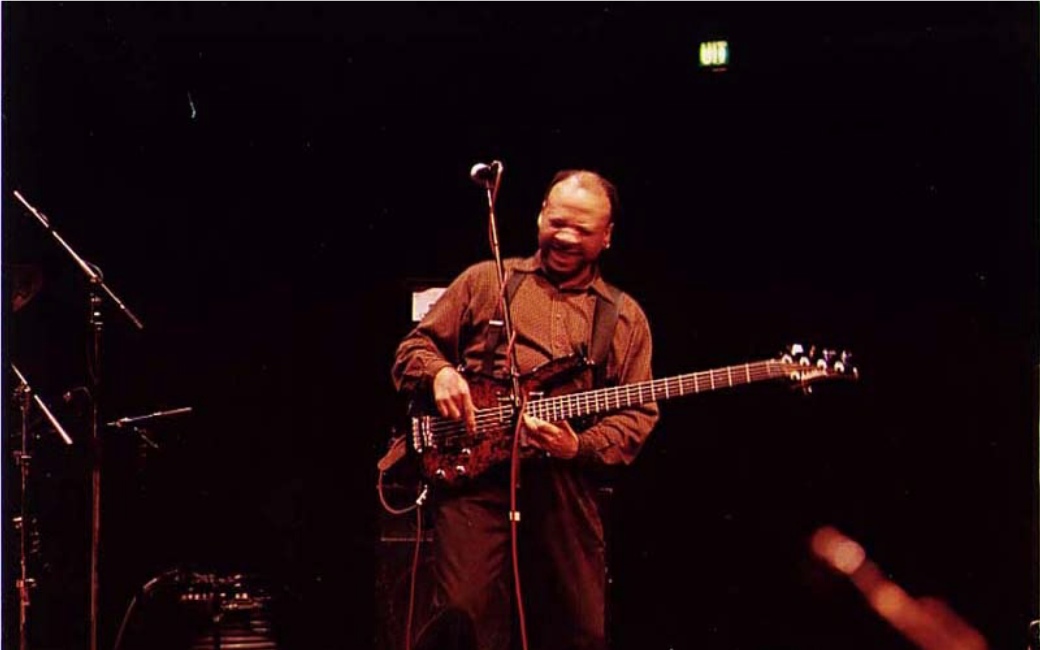
    Jerome Lee in concert in Teulada, Sardinia, Italy, 1998
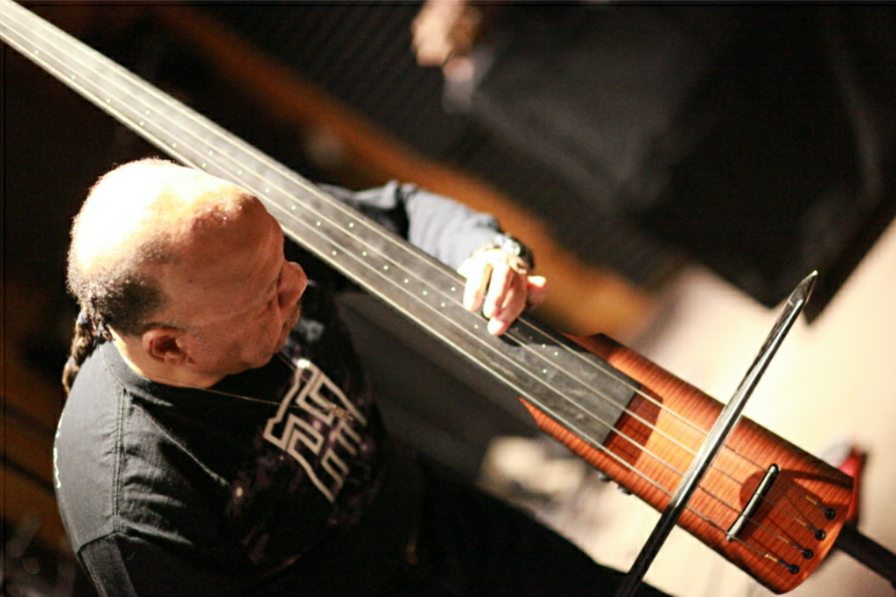
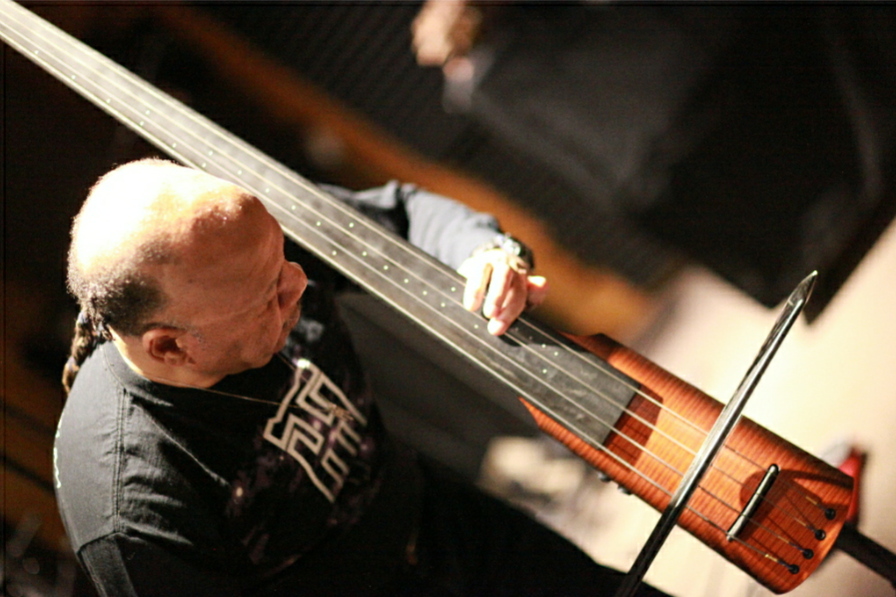
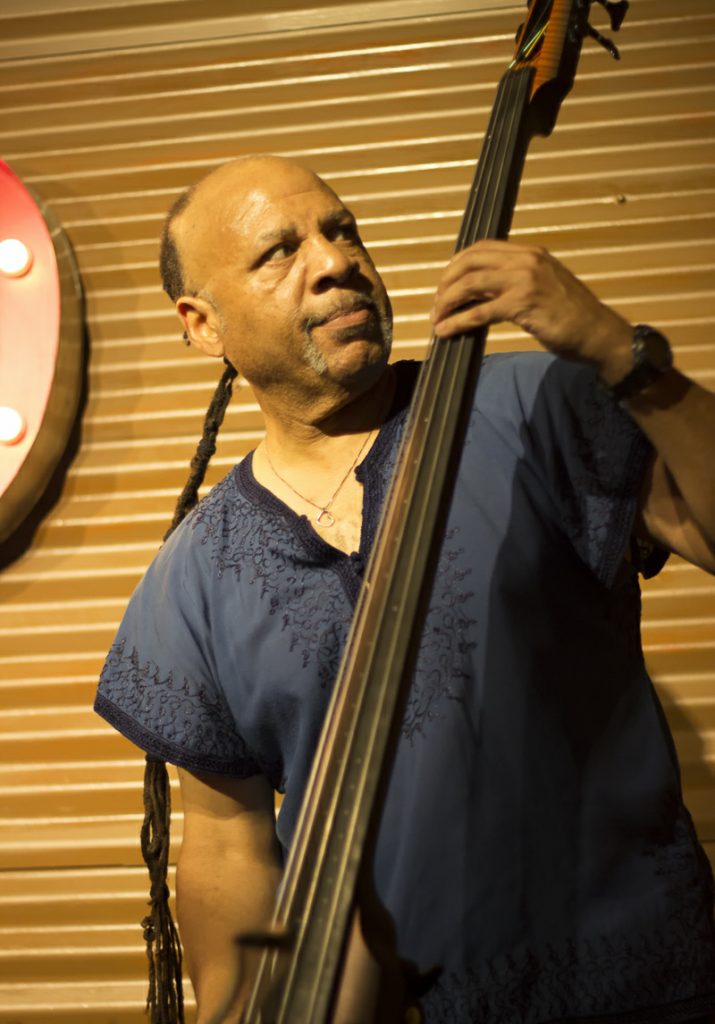
    Jerome playing the Spector NS-4 Electric Upright Bass in a studio in Parker, Colorado 2014
    Jerome Lee in a Farmingdale High School winter concert, 1973
  • Meeting Olympic Wrestlers, Music, and Rising Up (Originally posted on August 21, 2016) 

    Wrestling team Farmingdale High School 1974
    Farmingdale High School Varsity Wrestling Team 1974; Jerome is in the 2nd row, 2nd from the right

    Watching events on television of the Summer Olympics 2016 in Rio de Janeiro has got me to think about my own experience with Olympic level athletes when I was in high school. I was in my sophomore year, and my first year in high school. Back then, during my high school days, the high school freshmen went to school with the 7th and 8th graders; after finishing your freshman year you went to the final three years of your schooling at the local high school. I was interested in wrestling, and while I was in junior high school, I tried out for the team early on and made it. A couple of years of wrestling at that level would help hone your skills so that you could compete at the high school level where things become more serious. 

    My mini disaster of suffering a broken bone in my right hand during a wrestling match was still two years away, and as a sophomore wrestler there was little that I feared health wise. I was supple and strong, and tried each and every wrestling move shown to me by my coaches. We had a good team, some called it a good club, and we competed well in our division in Nassau County and on Long Island as a whole. It was a good time to be in wrestling, it seemed. I wrestled on the junior varsity team during my sophomore year, and the guys who wrestled on the varsity team were top notch athletes indeed. I remember one of the varsity wrestlers on our team that year eventually made it to the state finals in New York and placed third in the state. So, we felt as a team that we could compete. 

    What had happened at the Munich 1972 Summer Olympics was quite a tragedy and unfolded in front of the whole world. You can look it up; I won’t get into the horrible details here, but some of the lives that were lost were wrestlers. Although they were not wrestlers from the U.S., I and other wrestlers really felt the loss; we were filled with sorrow for such a loss of life. I watched on TV as the Munich games continued that year, and cheered for the wrestlers, from all of the nations really. The U.S. Olympic wrestling team did bring home some medals that year and I had no idea that I was going to meet a couple of these wrestlers during my sophomore wrestling year in high school. 

    Our high school coaches knew some of the people at the New York Athletic Club and had arranged for some of the U.S. Olympic wrestling team members to come to our high school and work out with us. They came to a couple of our practices that we regularly had on Saturday mornings during our wrestling season. It was amazing to me to wrestle athletes who had competed in the Munich 1972 Summer Olympics and had won medals. I watched our powerful varsity team members get thrown about, seemingly with ease by these fantastic wrestlers. I got my chance to wrestle too, and I was thrown about with ease as well. I have never put my hands on a person so strong, so fast and seemingly immovable on a wrestling mat as those from our U.S. Olympic wrestling team. Learning from those wrestlers was one of the greatest sports experiences of my life, if not the best. 

    During that 1972-1973 wrestling season, our high school wrestling team did quite well; its division competitions and league championship efforts revealed a team of wrestlers with some real heart, drive and dedication in what they believed. I wrestled as well as I could, and did well, and my coaches were pleased with what I had done as a young sophomore wrestler that year. 

    So, when I look at this year of 2016 and its Summer Olympics in Rio de Janeiro, I am reminded of the deep sacrifice an athlete must make to rise to the top of their sport. And it makes no difference if one is male or female, the effort required to rise to the top is the same for both. This realization that I had garnered from my wrestling days did find its way into other areas of my life, and my music life was included into this way of thinking. 

      I knew that I would have to sacrifice and train hard in order to find a way to rise up to the top of my musical profession. And when I say to the top, I mean this in a musician’s sense; I do not mean this in a music business sense. I don’t mean the top of some chart, or the most record sales, or the most public admiration. What I do mean about rising to the top in a musician’s sense is finding myself continuing to learn music, continuing to learn to play better on my chosen instrument, to take the risks required of me as a musician to break through with an original style, to do my best, and to bring joy to others who listen to my musical efforts. What I mean is to rise to the top of my own musical capabilities. 

      I have found myself playing music in many different places around the world, to many different people in our world. This takes some courage and confidence as an artist and musician to do. And rising up to the best of one’s abilities is the most that anyone can ask of us, and it is the most important thing that we can ask of ourselves. So, whether you are an athlete or not, play music or not, remember to seek to rise up to the top level of your ability in your life as best you can. Rise up to your own unique abilities, yes; they are yours and yours alone. 

    Rise up.

    Video of John and Ben Peterson of the USA Olympic Wrestling Team at the 1972 Summer Olympic Games in Munich, Germany.
  • For Trish Chappell and Tom Chappell (aka TN’T) (Originally posted on August 16, 2016) 

    For Trish Chappell and Tom Chappell (aka TN’T) (Originally posted on August 16, 2016) 

      After many years spent in Europe, after so many gigs and shows, after giving so many bass lessons, and after mixing audio at so many events, I got a call from my youngest sister in New York. She was calling me in the city of Amsterdam, The Netherlands, where I was living at the time. My sister dropped many hints on me during that particular phone conversation, and at long last I finally figured out that she was trying to tell me that she was pregnant with a new child. Now me, I will follow my youngest sister just about anywhere in the world. She said to me over the phone that day, “I need your help; I have my six-year-old son, my husband, and our elderly father to take care of at the same time. It’s a bit much; could you come here and help me out for a while?” As it seemed the proper time for me to leave Europe, the gigs were getting harder to come by and the money had all changed over to the monetary standard called the Euro, I went on ahead and made my way back to the U.S. in March of 2003. 

      When I arrived, I was in Newark, New Jersey. My sister and my brother-in-law came to the airport to pick me up. It was strange entering the U.S. once again, the terrible tragedy of September 11, 2001 had happened roughly a year and a half earlier, and there was still a lot of tension at the airport by the authorities as well as a lot of police and military presence at the bridges that we needed to cross to make our way out to Long Island where my sister and her husband lived. 

      After we had arrived at the house, I began my new life in the U.S. once again. I had been playing a lot of gigs and shows in The Netherlands, as well as Europe itself, and I began to look around and ask around for a new gig to play bass at. I had only been back a couple of weeks when one day my sister and my brother-in-law spoke to me about a married couple who lived just down the street from them, easily within walking distance from their house. “They have a recording studio in their basement, and they have been making music there for a while” my sister told me. I said to her that I was interested in meeting them, and so she arranged a meeting and a day or two later I walked down to their house from my sister’s house. I rang the doorbell, and a tall man came to the door and introduced himself as Tom Chappell. He asked me to come inside and then I met his wife, Trish Chappell. They were a beautiful couple; they both wrote songs and lyrics for all of the original music that they composed. 

      Tom sang and played the drums, as well as some keyboards, and his wife Trish was a singer. They had not only been in different bands on Long Island, but they had started their own group, led by both of them, and called it TN’T which stood for Trish and Tom. “Come downstairs to the studio and check it out” said Tom, as I followed him and Trish down to the studio they had set up. It was a Pro Tools based audio recording system that was residing inside of a powerful Apple computer, and Tom had all of the trappings and peripherals to connect microphones and many other outboard devices to the system and record them. I was very impressed as they played back their recordings from their first release as a couple; it was titled “Sweet Like Honey”. The sound was many things all at once to me. It was soulful, but funky; it was smooth, but the music had a grit all its own. 

       “Your sister told me that you play the bass Jerome, do you have one here?” asked Tom. I said yes, I do have one here. I then told them about my musical life as a bassist, and my many travels around the world as a musician and a technician. We hit it off as people, all three of us. I really liked their kindness, how very bright they were, and how dedicated they were to their music. More conversation that evening led to setting up recording dates in their basement studio. I began to show up with my bass at their studio in the late afternoon and stayed until the late night and early mornings to get some good bass parts down on the hard drive. Tom had been spending time coming up with bass lines on his various keyboards for me to listen to. I would then replace the keyboard bass parts with my bass guitar; we worked really well together developing the parts for each song. 
     
      On a couple of the songs, Tom had not come up with any bass lines yet, so he asked me to bring about some new bass parts from scratch, something that I love to do for brand new songs. As we continued to work together on their music during that summer of 2003, I found that I had made some new friends, and I was grateful to have both of them in my life. 

      The record that we were making was eventually titled “Something Good”. Tom had also teamed up with one of New York’s finest artists; the late great Ray Reid from the fabulous band Crown Heights Affair came in on the recording project for “Something Good” and produced a couple of its songs. I finished my bass parts for the remainder of “Something Good” once I had moved away from Long Island to Las Vegas, Nevada in the autumn of 2003. I would receive a new song template from Tom on Long Island, upload it to my recording program at home in Las Vegas, record my bass parts, and then render the audio file to match Tom’s computer operating system requirements. We got very good at this, and we became very effective with it too. 

      “Something Good” was released in 2006, and was met with critical acclaim, and a lot of new fans for TN’T were gained through that CD release. It was heralded by Bob Davis at Soul_Patrol dot com as one of the top ten releases of 2006 in the Nu-Soul category. To be well received by the public is an honor indeed. 

      Of course I listened to the music that I, Tom and Trish had made. Over and over, I listened to it, I liked it very much. But one thing that I began to notice about the recordings was Trish’s great singing voice. It is very special. There was something else great about her voice that I searched for in my mind for a while. Then it hit me one day; it was her uncanny ability to sing such great sub-hooks in the songs. You know, a tasty memorable short melody or saying that is sung within the framework of the song that seemingly becomes strong enough to be considered the song’s title by the listener. I was so taken aback by Trish’s ability to do this as she recorded her vocal parts. After a couple of years had gone by, I got the chance to ask Trish over the phone how she did that during her recordings. Was she thinking of this in advance of the music I wondered? Trish said to me that she actually was not thinking of developing those types of vocal hooks in the songs in advance, she said that she would really feel the spirit and vibes of the song and allow it to guide her musical and emotional state during her recordings. 

       I was glad that Trish had told me what was going on in her mind as she recorded her vocal parts. I continued to listen to “Something Good” for a couple of years more, and then I heard from Tom on the phone that he and Trish had started a new recording project. This time, I did all of my bass parts for the new CD entirely from Las Vegas and then sent the audio files containing my bass parts over the internet to Tom. He would then upload the audio files containing the bass parts that I’d sent him into his recording project. We worked together for a couple of more years this way of developing the music. Tom and Trish would record some scratch vocals as they went along with their projects, but the final vocals that they would record would come mostly toward the end of the recording process, when most of the music was already in place. 

      The new CD was titled “Don’t Let Go” and was released in the summer of 2014, and it too garnered positive critical and fan reviews. And once again I was taken aback by the vocal parts that Trish had recorded. She maintained her knack of being able to sing sub-hooks into the songs that made it seem as though what she was singing was the song’s actual title. So amazing to me what she sang onto the recordings. 

      Leading up to the release of the CD “Don’t Let Go”, TN’T did many live performances in the New York City area. Among the notable shows they did, the performances at the Sugar Bar in Manhattan where they brought a full live band were truly standout to all those in attendance. You see, the Sugar Bar in Manhattan is owned by the late Nick Ashford and his wife Valerie Simpson, a couple of the greatest songwriters and singers in the history of the music industry. 

      Tom told me on the phone one day that he found the crowd’s reaction to TN’T’s performances there somewhat amusing, because of the obvious comparisons that people were trying to make between theirs and Nick and Valerie’s accomplishments. While they were kind comparisons, I knew that Tom and Trish had established something new for the listeners, something fresh for those in love with the soul music of yore but still hungering for the new and modern soul music. Trish and Tom not only delivered this new and fresh soul music to the masses but gave the listener something to think about as well. Life, and its ups and downs were included in TN’T’s songs; their lyrics spoke of the things in life that so many of us go through daily as people. They sang also of hope, and they sang of love and togetherness. They had heart and soul as people, and that heart and soul found its way into their music. 

       I speak glowingly of this wonderful couple; I love them very much. We do our best as artists to give our best each and every moment that we have to share our craft with other great artists. I cherished the time that I had spent on Long Island with Tom and Trish, and I always enjoyed what we had created as artists and musicians. Sadly, Trish Chappell passed away in May of 2016, and much too soon for all of us who loved her. She was a kind and beautiful lady to all that she had met in life. My life is better for her having been in it, and I will always remember her smile and laugh; it could always light up any room. As artists and as people, we realize that the people that we love in our lives are there for but a season, and that we should embrace the people that we love in our lives as often as we can. Rest In Peace Trish Chappell, you are loved and missed by me and many others. Namaste. 

    The single “Today” by Trish Chappell and Tommy Chappell aka TN’T from their CD titled “Don’t Let Go” c. 2013 tritommusic
    “Something Good” by TN’T released in 2005 and selected as Best of 2006 in the Nu-Soul category by Soul Patrol dot com
    “Don’t Let Go” by TN’T released in 2014 received fine accolades from artists and listeners across the internet music community
    “Sweet Like Honey” by TN’T released in 2003 continued to grow their fine reputation in the music industry
  • Live Universal Audio Thoughts (a blog re-post from August 2016)

    Live Universal Audio Thoughts (a blog re-post from August 2016)

      When I think about a life in pro audio, and especially experiencing live audio, there are aspects of it that, to me, are universal. When I have those times when I think about leaving a pro audio life (as I have recently), audio seems to call back to me to always consider staying. And whether I remain or leave a pro audio life, here is what Great Audio has revealed to me and my understanding.

      Audio bathes us like no other experience. When audio is present and great, what can be heard can feel akin to standing in the bright light of sunshine. When audio is present and great, what can be heard can also feel akin to standing in complete darkness, with only the stars to guide oneself.

      Great Audio, operated by persons, does not discriminate nor mind about the content of what is being delivered through its numerous designs. Great Audio attempts to ensure that all humans present are moved by it and respond to it with emotion to its delivered content.

      Great Audio does not discriminate nor mind about the distinct characteristics of the human operating it. Great Audio does not mind which nation the operator may belong to or reside in. Great Audio does not mind the shade of dermis of the operator.  Great Audio does not mind which gender is operating it. Great Audio does not mind a person’s size or weight. Great Audio does not mind if one is rich or poor, young or old. Great Audio does not mind if one’s hair is short or long, or if the operator is bald. Great Audio simply does not mind any of this. Because when all of the collective human audio operators around the world deliver Great Audio, then Great Audio is made present for all other humans in attendance to experience.

      Great Audio does mind that the operator cares. Great Audio seemingly speaks to the operator and wonders if the operator can hear its presence, and with the largest audio designs, wonders if the operator can also feel its presence as well. Great Audio cares if the operator is safety conscious, it will seemingly conform and abide to the caring operator’s wishes. Great Audio will also safely conform and abide to the caring technicians who build its on site design, appliances and apparatus.

      At live events, Great Audio seems to wonder if the operator is excited about its presence and funnily enough, Great Audio seems to be very satisfied when the operator is exhilarated by its presence.

      After many years of my experiencing Great Audio luckily around our planet, I am thankful that its working aspects and profound impact upon people will extend itself in the human experience well into the near and very distant future. And I feel strongly that this will take place, regardless of my own future career choices.

    Jerome Lee – original post from August 9, 2016, at www.jeromelee.net

    The great ventriloquist Terry Fator performing his show at the Mirage Resort and Casino in Las Vegas, NV during 2015. It may be one of Terry’s shows that I mixed inside the Terry Fator Theater during the years 2013 – 2016.

  • From Bassist Jerome Lee

    From Bassist Jerome Lee

    Thank you for visiting my new WordPress site. This site serves as an extension of the Blog page at my official website. As a musician and bass player for over 50 years, I wanted to simply and humbly share my experiences in the music industry with fans of mine and music listeners alike. It has been quite a journey indeed, and I began posting blogs at my official website back in 2016. I will post blogs from that time over here and they will lead up to current blogs I have written more recently. Again, thank you for visiting!